

Parts of Northwestern Ontario proposed to move to permanent Daylight Saving Time
Tim Brody - Editor
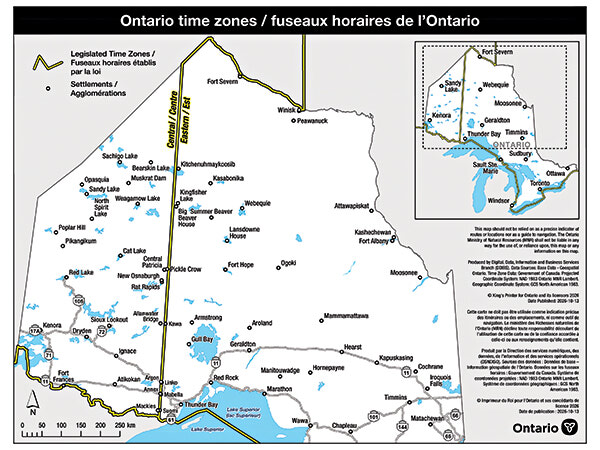
Communities in Northwestern Ontario’s Central Time Zone west of the 90th meridian, including Sioux Lookout, are to remain on Daylight Saving Time year-round effective November 1, 2026.
The Government of Ontario announced on Oct. 13 in a news release from the Attorney General that it, “intends to make daylight saving time permanent in Kenora and the northwestern regions of Ontario that have historically been aligned with neighbouring Manitoba.”
The provincial government shared that the proposed regulatory change would be implemented by November 1, 2026, “to ensure there is no disruption for businesses, families and Indigenous communities in Ontario’s central time zone.” The provincial government added, “Maintaining alignment with Manitoba would help businesses operate more efficiently across provincial boundaries, while making it easier for residents and service providers to coordinate activities such as health-care appointments and travel.”
“Providing certainty and predictability is essential to supporting strong communities and a competitive economy,” said Attorney General Doug Downey. “By keeping this part of the province aligned with Manitoba, our government is taking a practical, common-sense approach to avoid unnecessary disruptions and ensure economic stability in communities that reside in Ontario’s central time zone.”
“This decision comes after considerable engagement with communities throughout northwestern Ontario, including Indigenous leaders, that began following Manitoba’s declaration of permanently moving to daylight saving time. This engagement revealed substantial support for maintaining alignment with Manitoba. The government will continue to work with local leaders and communities as this proposed change moves forward,” the provincial government shared.
“Through the collective efforts of communities and First Nations across the northwest, we’ve led a process to build consensus the right way, with detailed and nuanced considerations,” said Greg Rickford, Kenora-Rainy River MPP and Minister of Indigenous Affairs and First Nations Economic Reconciliation and Minister Responsible for Ring of Fire Economic and Community Partnerships. “What has emerged is unanimous support across the region to move to permanent daylight saving time, and our government is proud to support the people of northwestern Ontario as we make this decision, together.”
“Under the proposed change, affected communities in northwestern Ontario that currently change their clocks seasonally would not need to turn them back on November 1, 2026. Communities west of the 90th meridian would share the same time as the remainder of Ontario during the winter months. This change would be made through a regulation under the Time Act,” the provincial government informed.
Rickford shared in a separate statement, “Manitoba’s decision to move to permanent Daylight Saving Time sparked important discussions across Northwestern Ontario about what this change would mean for our region.
“With the collective efforts of communities, First Nations, healthcare leaders, and residents, we have worked together to build consensus the right way.
“Through formal and informal polling, positions set out by First Nations leadership and community resolutions, it was abundantly clear were not changing our clocks.
“Reflecting the unanimous consensus across the region, our government is announcing that a regulatory change under the Time Act will be given effect to permit Northwestern Ontario to move to permanent daylight saving time effective November 1st 2026.
“Standing with the people of Northwestern Ontario, our government is supporting a practical, regionally driven solution that reflects the overwhelming consensus to align with Manitoba, bringing clarity and certainty to the Northwest.”
Following the provincial announcement, Deputy Leader of the Ontario NDP, MPP Sol Mamakwa (Kiiwetinoong) released the following statement:
“With the recently-announced changes to time observation across the provincial border, people across Northwestern Ontario have been advocating for a common solution for time observation. “This concern has also been reflected in a survey that our office conducted, to push the Premier and his government to listen to northern communities and do the right thing.
“After bringing the voices of people across the northwest to the table, we are happy that daylight savings will be implemented permanently, bringing the northwest in line with our neighbors in Manitoba. We are proud of our collaborative efforts to deliver what works for the North. Meegwetch to everyone who reached out and shared their thoughts on this important decision.”
The provincial government further shared:
- Daylight saving time is the portion of the year from March to November during which the time in effect is one hour ahead of the standard time observed during the rest of the year.
- The central time zone begins west of the 90th meridian, a north-south line of longitude that crosses northwestern Ontario.
- Ontario communities in the eastern time zone would continue to change their clocks twice a year.
- On September 17, 2026, Manitoba announced plans to adopt permanent daylight saving time beginning November 1, 2026.
- The Time Amendment Act, 2020 would make daylight saving time permanent as the standard time year-round in all of Ontario, when brought into force. Coordination with neighbouring jurisdictions such as Quebec and New York is important for trade, the stock market and broadcasting.
Summer of 1938, Building of Frog Rapids Bridge.